Skip to content
Santa Clara Sub-Zero RepairSub-Zero built-in diagnostics

Symptom diagnosis · Santa Clara

Sub-Zero Leaking Water in Santa Clara

A leaking Sub-Zero in Santa Clara is a water-path problem — defrost drain, ice-maker line, filter housing, pan or door seal — not usually a cooling failure. Settle whether the water is on the floor or inside the cabinet, protect the hardwood, then book a model-matched repair.

5.0/5 · 676 verified customer reviews

950509505195054Floor-safeModel-first

Read the water first

Where Santa Clara Sub-Zero leaks really start

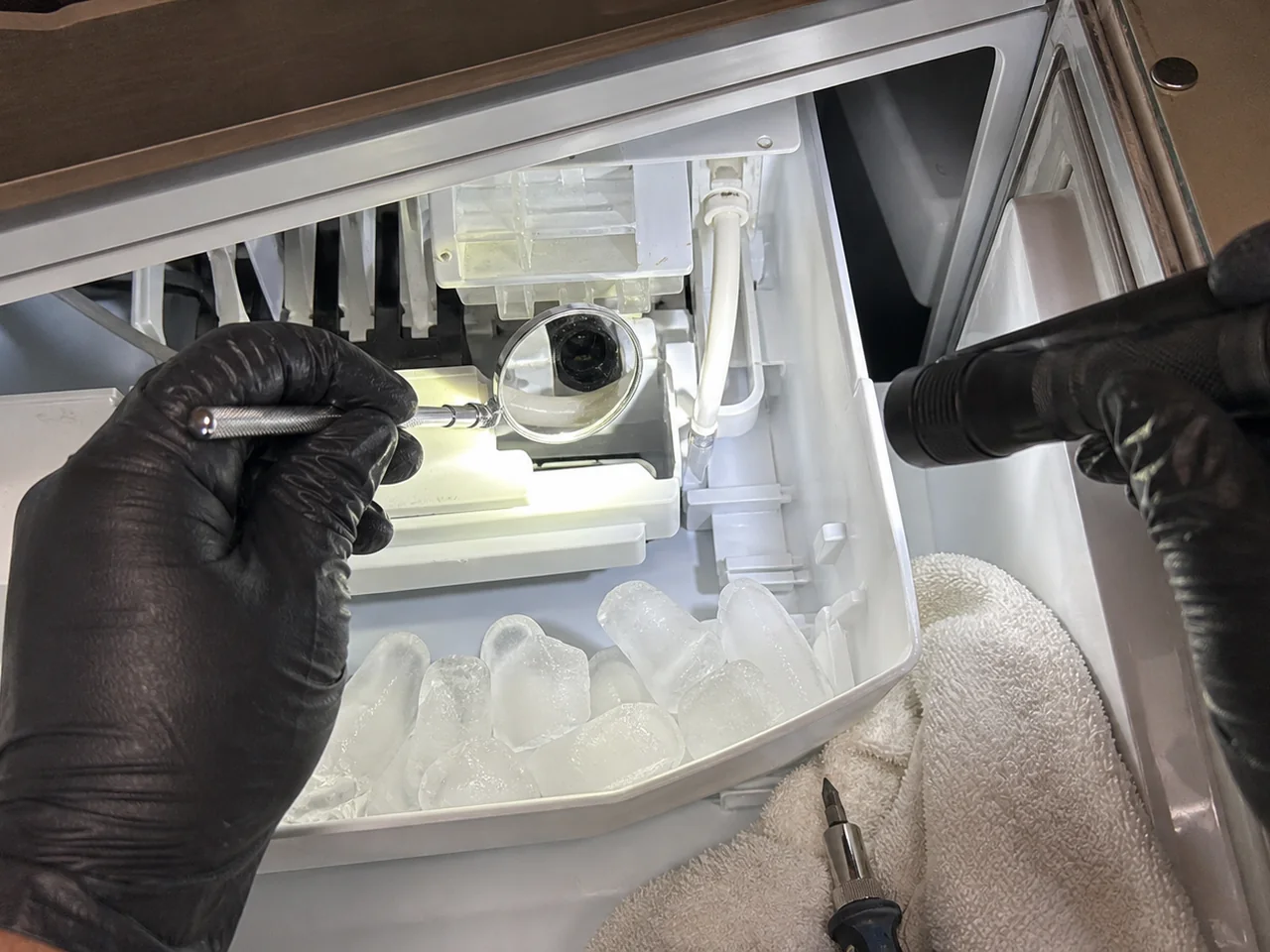
Technician inspecting the ice-maker water line on a Sub-Zero built-in during a Santa Clara leak diagnosis

A Sub-Zero that leaves a puddle on the kitchen floor or a slick film under the crisper drawers is almost never a refrigeration failure. It is a plumbing or drainage path that has quietly gone wrong, and the cooling system is usually working fine while it happens. In a Santa Clara built-in the stakes are larger than the puddle looks: a column or under-counter unit sits inside finished cabinetry over engineered hardwood or wide-plank oak, and a thin run of water that wicks beneath a custom toe-kick can swell millwork days before anyone notices the source. So the first job is to read where the water is coming from — not to start pulling the unit.

Local water matters here more than people expect. Santa Clara taps a groundwater-and-imported blend that runs moderately hard across 95050, 95051 and 95054, the kind that leaves a pale ring on a kettle. That same mineral load slowly narrows the pencil-thin defrost drain and crusts the ice-maker fill path, so leaks in this part of the South Bay tend to begin at the drain or the water line rather than at a split housing. A technician who knows the local profile checks the scale-prone parts first instead of guessing.

You can narrow it down yourself in a few quiet minutes. Decide whether the water is appearing inside the cabinet or arriving on the floor, and whether it is fresh and odorless — supply or defrost water — or stale, which points at an overfull pan that has been sitting beneath the unit. Lay a folded paper towel against the toe-kick and a second sheet under the lowest drawer, then watch which one darkens first. That single observation steers the whole repair.

Find the source

A six-step home check before the visit

  1. Map the leak with paper towels: Set a folded towel at the toe-kick and another under the lowest interior drawer. The sheet that wets first tells you whether the water is leaving the cabinet at the floor (plumbed or pan side) or collecting inside (defrost side) before you move anything.
  2. Read the water itself: Touch it. Cold, clear and fresh suggests a live supply line or fresh defrost melt; cloudy or slightly stale water usually came from a drain pan that overflowed. A faint mineral grit on your fingertip is a Santa Clara hard-water clue pointing at a scaled drain or valve.
  3. Check the defrost drain channel: Look for ice building at the very bottom of the freezer or a frozen bead in the drain trough. A defrost drain choked by scale or food film backs up each cycle, then sends melt over the lip and onto the floor. Do not chip at ice with metal — note it and photograph it.
  4. Inspect the filter head and fill line: Open the grille or access panel and look at the water-filter housing, the saddle fitting and the plastic fill tube to the ice maker. A weeping filter head, a loose collet or a pinhole in an aging line drips at the front feet — the most common plumbed leak on Santa Clara built-ins.
  5. Rule the door seal in or out: On a humid June morning or after a long inland-heat door-open cycle, a tired gasket can sweat and leave moisture at the base of the door that mimics a leak. Run a dollar bill along the seal; if it slides out with no drag, the gasket — not a pipe — may be the culprit.
  6. Shut off, protect, and book the visit: If water is active, close the unit's supply shutoff, lift standing water off the floor immediately to protect the hardwood, and photograph the source area. Then call (669) 336-6357 or book online so the technician arrives with the matching valve, line or drain parts for your model.

These are safe owner checks. Pulling a built-in forward, opening sealed lines or clearing a packed drain is technician work — book it rather than risk the liner, coil or your flooring.

Common leak origins

What we check on a Santa Clara built-in

Scaled or frozen defrost drain

The most common interior leak. Mineral scale and food film narrow the small drain that carries defrost melt to the pan; once it backs up, water sheets out under the crisper and reaches the floor. We clear and flush the channel and confirm flow rather than swapping parts blind.

Overfull condensate / drain pan

Under the cabinet, the evaporation pan can crack, shift during a remodel, or simply receive more water than it can shed in a tightly enclosed Santa Clara cabinet that traps heat. We check pan seating, the drain tube and surrounding airflow.

Ice-maker fill line and inlet valve

A weeping plastic fill tube, a stuck inlet valve or a frost plug at the fill cup leaves clear water at the front or inside the freezer. Hard local water shortens the life of these parts, so we inspect the whole fill path, not just the visible drip.

Water-filter housing and head

A cross-threaded filter, a perished O-ring or a hairline crack in the housing weeps at the front feet every time the line is pressurized. We pressure-check the head and replace the seal or housing with the genuine OEM part for your serial.

Supply / dispenser fittings

Compression and quick-connect fittings behind the unit loosen over years of vibration. On panel-ready columns the leak hides until it reaches the floor, so we trace the line back from the wall valve before condemning the appliance.

Door gasket sweating

In warm South Bay weather a worn or misaligned gasket sweats and drips at the door base, looking like a plumbing leak. A paper-strip test and a hinge check tell us whether the seal, the hinge or the cabinet alignment is at fault.

Protect the floor

What not to do while it is leaking

  • Do not chisel ice out of the freezer drain with a knife or screwdriver — you can puncture the liner or the coil behind it.
  • Do not run a hair dryer or heat gun into the cabinet to clear a frozen drain; uncontrolled heat warps trays and can crack plastic.
  • Do not keep stacking towels and ignore it — water under a sealed toe-kick wicks into hardwood and engineered flooring far faster than it evaporates.
  • Do not assume a new filter fixed it; confirm the leak stops over a full day before declaring victory, because a scaled drain often returns.

Once the source is found, most leaks are a modest line, valve, seal or drain repair rather than anything in the sealed system. For the full picture of what this repair costs in Santa Clara, see the 2026 price guide. If the cabinet is warming as well, compare notes with the not-cooling diagnostic, and check the related ice-maker and water-line page when the leak sits near the fill cup.

Short answers

Leaking-water questions

Why is there water on my kitchen floor under a Sub-Zero in Santa Clara?

Floor water almost always comes from the plumbed side — the ice-maker fill line, the water-filter housing, a wall-valve fitting — or from a drain pan that has overflowed because the defrost drain backed up. Clear, cold water at the front feet points at the supply path; stale water means the pan. The cooling system is usually fine, so the fix is a line, valve, seal or drain clearance, not a compressor.

Does Santa Clara's hard water really cause Sub-Zero leaks?

It contributes. The moderately hard groundwater blend served across 95050, 95051 and 95054 lays down scale that narrows the thin defrost drain and stiffens ice-maker valves over time. That is why local leaks tend to start at the drain or the fill path. A periodic drain flush and filter change slows it down considerably.

Is a leaking Sub-Zero an emergency?

Treat active floor water as urgent in a Santa Clara built-in installation, because the unit sits over finished flooring and inside cabinetry where water hides under the toe-kick and wicks into millwork. Shut off the supply, lift the standing water right away, and book a prompt visit. If water is reaching an outlet or you smell anything electrical, stop using the unit.

Can I just clear the defrost drain myself?

You can safely melt a light frozen drain by leaving the freezer off with the door open and towels down, but stop short of poking metal tools into the channel — the liner and coil sit close behind it. A recurring clog usually means scale built into the trough, which is what a proper flush and a flow check resolve.

What should I have ready when I book?

A photo of where the water shows, a photo of the model and serial tag, and a note of whether the water is fresh or stale. For a Rivermark or Old Quad built-in, a wide shot of the cabinet and the wall shutoff helps the technician arrive with the right line, valve or drain parts and a plan to protect the floor.

Verified customer reviews

Leak repairs across Santa Clara, reviewed

Woke up to water creeping out from under our panel-ready column near the Tasman townhomes. He traced it to a cracked filter housing, not the fridge itself, replaced the head with the genuine part, and dried and checked under the toe-kick before leaving. No more floor puddle.

— Priya N., Rivermark

Our older built-in was dripping inside under the crisper. Turned out the defrost drain had scaled shut — classic hard water, he said. He flushed it, confirmed the melt was draining to the pan, and showed me how to keep it clear. Honest about it being a clean-out, not a part.

— Marcus D., Old Quad

I was sure the compressor was dying because of the water, but it was just the ice-maker fill line weeping at the back. Quick fix, protected my engineered floors the whole time, and the $89 diagnostic went toward the repair.

— Lauren H., Laurelwood

Why this team

Leak diagnosis that protects the cabinet

  • Independent built-in specialists since 2005 — we trace the water path before anything is pulled from the cabinet
  • Genuine OEM Sub-Zero parts keyed to your model and serial — fill lines, inlet valves, filter housings, gaskets and drain components
  • Floor and trim protection on every visit, because Santa Clara built-ins sit over hardwood and inside custom millwork
  • Drain flushing and flow verification rather than blind part swaps on scale-prone South Bay water
  • An independent shop — not affiliated with or authorized by Sub-Zero — with a 365-day parts-and-labor warranty and an $89 diagnostic applied toward the repair

Independent appliance repair service — not affiliated with or authorized by Sub-Zero Group, Inc. or any appliance manufacturer; brand names identify the appliances we service. Serving Santa Clara and the northern South Bay; see our service areas and common problems hub.

Call (669) 336-6357Book online